

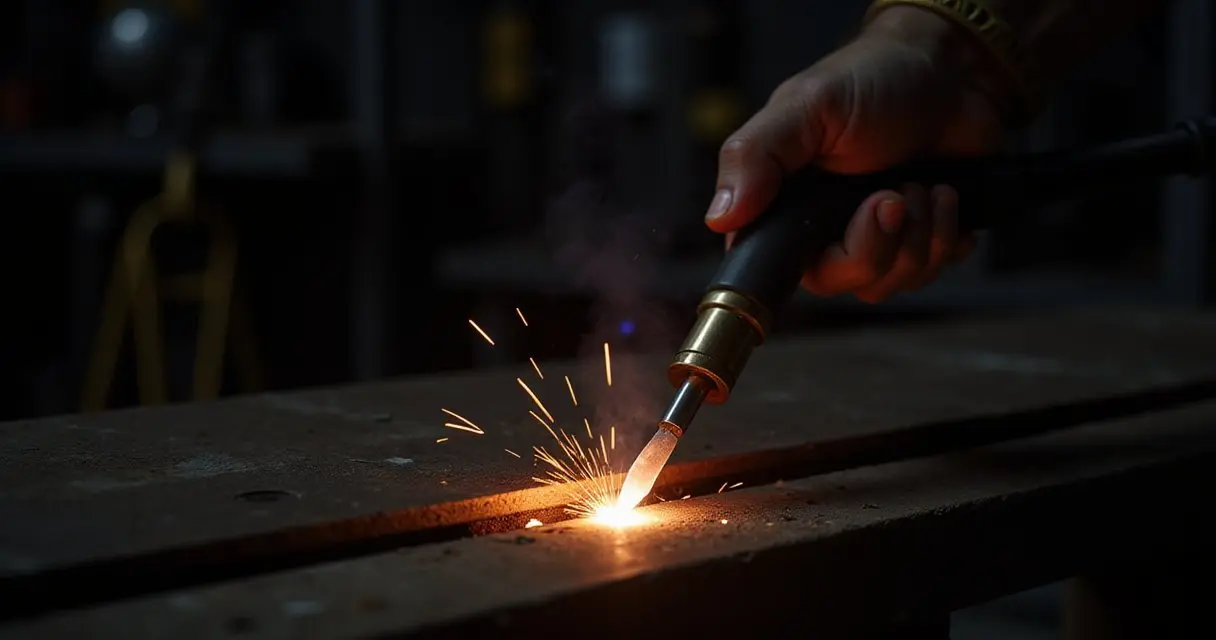
If you are looking at the skilled trades, start with welding: welders are among the most in-demand workers in the country at the moment.
Every factory, shipyard, pipeline, and construction crew needs someone who can join metal, and a lot of them hire quickly when a candidate turns up ready to go.
The money is good for a career that skips the college degree, and you carry the skill with you between employers and across state lines.
Advertisement
Start learning to weld today
Free, self paced, and you finish with a real certificate of completion.
Historically, cost was the obstacle. A welding program might take thousands of dollars from you before you ever struck an arc.
Now the first step costs far less. Welding theory, safety, and fundamentals are available online for free, and you decide when to study.
In the sections below we break down what welding certification really means, the best free courses to start with today, and the honest path from free course to paying job.
Why a welding career pays off
For someone without a degree, welding is one of the fastest ways to get into skilled trade work.

Welders earn a median of about $51,000 a year, and the highest paid ten percent pass $75,000, the Bureau of Labor Statistics reports.
Pay at the start is lower, and then it climbs quickly with each process and certification you add.
Demand is steady for an honest reason: the field is not booming, it is losing thousands of workers to retirement each year.
Advertisement
Looking ten years ahead, the BLS projects around 45,000 welding openings a year, and most come from replacing workers rather than from growth.
The result is real, ongoing room for new welders, even with a small growth rate in the headlines.
Specialty work pays even more. Welders who travel, work underwater, or work on pipelines can earn well above the median.
Those jobs are the exception and not your starting point, so keep the median in mind as the honest expectation early on.
Where welders work and which jobs pay most
Welding is not one job. The same skill is used across a dozen industries, and the setting shapes the pay you get.
Most entry welders get their start in manufacturing or fabrication shops, making everything from trailers to structural steel.
Welders also work with construction crews on buildings, bridges, and heavy steel, frequently with higher pay and steady overtime.
Harder fields bring the big money. Underwater, aerospace, shipyard, and pipeline welders earn well above the median.
Expect those jobs to ask for more skill and more certifications, and sometimes travel or rough conditions, as the price of that pay.
The honest plan keeps it simple. Get your start in a shop, build clean technique, then aim for the specialty paying what you want.
What welding certification actually requires
Most of the confusion around welding lives right here, so this is the honest version.
A free online course ends with a certificate of completion, which proves you studied the theory and nothing more.
It is not a professional welding certification, and the certification is what employers actually test for.
At the top of the list sits the AWS Certified Welder credential from the American Welding Society.
The test normally takes a few hours and is held in person, on real metal, with the result judged against AWS code.
That credential cannot come from an app or a video. The skill must be physically there in your hands.
How online welding training works, and where it stops
An online welding course takes care of what a screen is genuinely able to teach.
You move through short lessons on welding processes, safety, metallurgy, and how to read blueprints and weld symbols.
Your progress is stored on most platforms, so you can study on a break or squeeze in a few nights a week.
When you are done, you get a certificate of completion worth adding to your resume.
Building muscle memory is beyond it. A clean bead requires a torch, practice, and plenty of time.
So the free course is step one: it lays the foundation, but it is not the finish line.
What a free welding course covers
A serious online welding course teaches what you need to know before you pick up a torch for the first time. Expect lessons on:
- The main processes: MIG (GMAW), TIG (GTAW), stick (SMAW), and flux core (FCAW)
- Shop safety, protective gear, and fume and fire hazards
- Basic metallurgy and how different metals behave under heat
- Reading blueprints, weld symbols, and joint types
- Inspection basics and how to spot common weld defects
Arrive with this knowledge already in place, and your hands on hours are spent improving rather than relearning the basics.
Which welding process should you learn first?
Welders work with four main processes, but you do not have to learn them all at once.
MIG (GMAW) is the easiest to learn and the most common process in shops, which makes it the usual first choice for beginners.
MIG is forgiving and fast, and it appears in everything from auto repair to general manufacturing.
Stick (SMAW) is normally second. It is tough and reliable outside and on construction sites, even with wind and rusty metal.
TIG (GTAW) is the cleanest and the hardest of the group, used on thin metal, stainless, and aluminum when the weld has to look perfect.
Use MIG to build confidence, and bring in stick and TIG when the jobs you are after begin to demand them.
Best free and low cost welding courses
Each platform below is real, and we flag honestly which parts are free and which cost money.
None of these certifies you to weld professionally. They teach only the theory and fundamentals.
| Platform | Cost | Format | Best for |
|---|---|---|---|
| Alison | Free | Web course | A free, reputable course with a completion certificate |
| Cursa | Free | App + web | A free course with an explicit free certificate |
| SkillCat | Free basics | App + sims | Mobile lessons with a welding safety focus |
| Lincoln Electric | Free | Videos / academy | Manufacturer training from a trusted welding name |
| AWS Learning | Paid (~$350) | Self paced + exam | An official AWS certificate and CEUs |
To start in one place only, go with Alison's welding course: it is free, well known, and ends with a certificate.
How long it takes and what it costs
Online theory moves fast and costs little. Most free courses wrap up within a few hours to a couple of weeks, at your own pace.
Real skill is a longer project. A focused welding certificate program generally runs three months to a year.
The costs line up the same way. Theory may be free, while the hands on work and the testing are what you pay for.
You will pay about $75 to apply for AWS Certified Welder, plus a small fee every six months to keep it active.
Depending on the position and process, the weld test itself usually costs $300 to $450 at a testing facility.
If funds are limited, go for the free paths first. Veterans and young adults can often train free through programs like Job Corps.
Can an online course replace in person welding training?
No, and that is the point most beginners miss.
Welding is a physical skill, and the weld itself is what gets judged.
You build that skill in a community college, a trade school, an apprenticeship, or a shop job.
The free course trims the learning curve and proves you took initiative. Time on the torch remains irreplaceable.
Will employers accept an online welding certificate?
It all depends on what you want it to show.
As evidence that you know the fundamentals and took initiative, yes, it helps your application.
As a swap for a weld test, no. A shop still expects to see you weld.
The honest way to use it is easy. Study for free, learn the language and the safety, and prove the skill in person.
If a job requires a specific certification, make a plan for the AWS Certified Welder test at an approved facility.
Red flags to watch out for
Free welding certificates are a common search, and the topic pulls in a few bad actors because of it.
Keep your guard up around any site that promises an instant welding certificate with no course and no test.
Treat with suspicion any page implying an online course equals an AWS certification or a license to weld.
And steer clear of big upfront fees for certificates no employer recognizes.
Legitimate platforms are open about covering only the fundamentals, and that openness is the sign you want.
Your next steps
A big tuition bill no longer stands at the start of a welding career.
Select one of the free courses above and finish its theory this week.
Then put your hands on a machine through a local class, an apprenticeship, or an entry level job in a shop.
Once you feel ready, schedule a weld test or the AWS Certified Welder exam to make it official.
That is how curious becomes a paid welding job, one honest step at a time.
Frequently asked questions
Can I earn a free welding certificate online?
Yes. Platforms such as Alison and Cursa have free welding courses with a free certificate of completion. Bear in mind that this kind of certificate shows you studied the theory and is not, alone, a professional welding certification.
Can someone become a welder from an online course alone?
No. An online course teaches theory and safety, while welding itself is a hands on skill. Employers hire after real practice and, in most jobs, a passed weld test.
How much does a welder make in the US?
The Bureau of Labor Statistics reports a median of about $51,000 a year for welders. The lowest tenth earn under $38,000 and the top tenth over $75,000, while pipeline and specialty welders earn more.
Is the AWS Certified Welder test available online?
No. This hands on skills test is taken in person at an AWS Accredited Testing Facility, where you weld in set positions and processes judged against AWS code.
How much time does it take to get welding certified?
Online theory takes a few hours to a few weeks, depending on your pace. Gaining the skill and passing a weld test usually needs months of regular practice.
Do employers take online welding certificates seriously?
As a foundation and a sign of initiative, they do. As a replacement for a weld test, they do not, and most shops still want to see you weld first.
Is a high school diploma needed to start welding?
Not for taking a free online course. Some trade schools, apprenticeships, and employers may require it, so review the rules of the program you choose.